
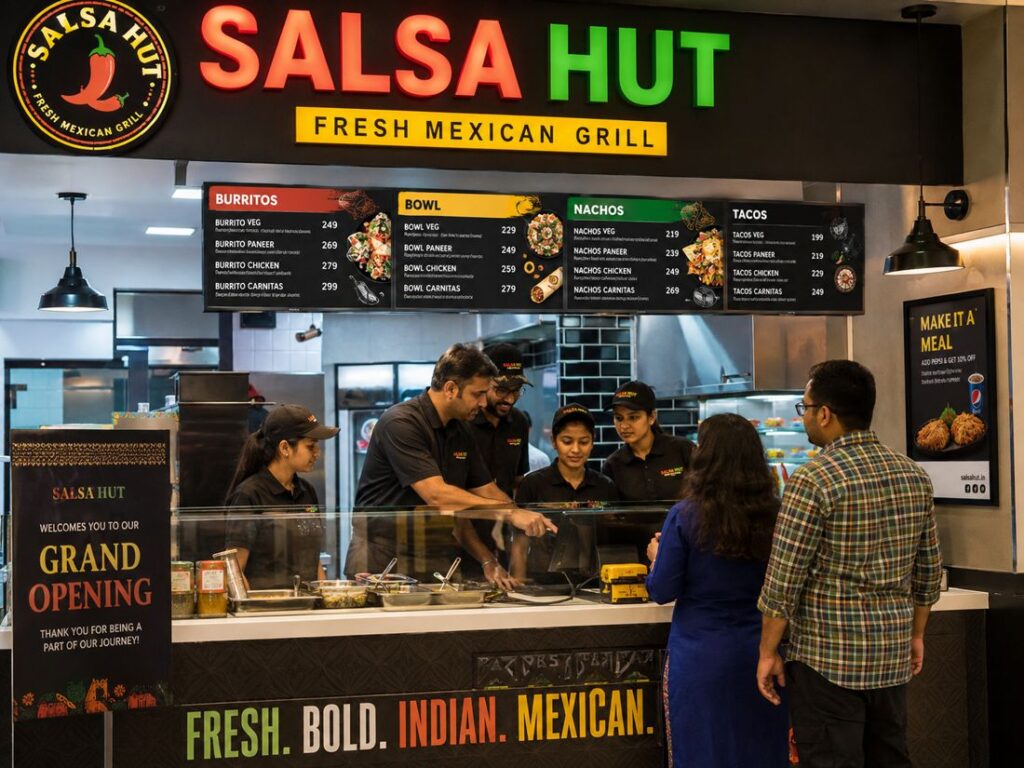
The Indian food-service market continues to create opportunities for entrepreneurs who want to enter an established business model rather than build a restaurant brand from the ground up. A food franchise can provide access to a recognised brand concept, standardised operating processes, menu systems, training, marketing support, and an established business format.
Among emerging food concepts, Salsahut food franchise can be considered by entrepreneurs looking for a focused food outlet model. Before investing, we should examine the expected investment, outlet format, operating expenses, location requirements, revenue potential, franchise support, and the overall economics of the business.
This guide covers the Salsahut franchise opportunity in India while also placing it within the broader food franchise in India market.
What Is a Salsahut Food Franchise?
A Salsahut franchise represents a branded food business model where franchise partners operate an outlet using the brand’s approved concept, menu, processes, visual identity, and operating standards.
Instead of developing every part of a restaurant independently, franchisees generally work within a predefined business framework. Depending on the franchise agreement, the franchisor may provide assistance with location selection, outlet design, equipment planning, staff training, menu implementation, marketing, technology, procurement, and operational guidance.
For entrepreneurs entering the food sector for the first time, this structure can make the process more organised. However, the actual commercial terms should always be verified directly with Salsahut before making an investment decision.
Why Consider a Food Franchise Business in India?
The food franchise business has become an attractive format because food is a recurring-consumption category. Restaurants, quick-service outlets, cafés, snack counters, delivery kitchens, and specialised food brands serve customers across residential, commercial, educational, and high-footfall areas.
A franchise model can also provide a structured alternative to starting an independent restaurant.
Key areas we should evaluate include:
- Brand recognition
- Initial investment
- Franchise fee
- Outlet size
- Equipment requirements
- Menu pricing
- Gross margins
- Rent and staffing costs
- Delivery potential
- Local competition
- Royalty and marketing fees
- Break-even period
- Expected return on investment
A food franchise should therefore be evaluated as a complete business model rather than simply by looking at the franchise fee.
Salsahut Franchise Cost in India
The total investment required for a Salsahut outlet can depend on the business format, location, outlet size, equipment, interiors, working capital, and other setup requirements.
Rather than relying on an outdated figure published elsewhere, we recommend obtaining the latest commercial proposal directly from the brand.
A typical restaurant franchise cost in India can include several components:
| Investment Component | What It May Cover |
|---|---|
| Franchise Fee | Brand and franchise rights |
| Interior Setup | Furniture, flooring, branding and décor |
| Kitchen Equipment | Cooking, refrigeration and preparation equipment |
| Signage | Exterior and interior brand signage |
| POS & Technology | Billing and order-management systems |
| Licences | Applicable registrations and approvals |
| Initial Inventory | Ingredients, packaging and supplies |
| Staff Recruitment | Hiring and initial training |
| Marketing | Launch and local promotional activities |
| Working Capital | Operating expenses during the initial period |
The final Salsahut investment should be confirmed from the company’s current franchise documentation.
Can Salsahut Fit a Franchise Under 5 Lakh Budget?
Many new entrepreneurs search for a franchise under 5 lakh because they want to enter the food industry with limited capital.
A franchise in India under 5 lakh may be possible for certain small-format food concepts, kiosks, carts, counters, or low-infrastructure models. However, we should distinguish between the franchise fee and the total business investment.
If a franchise advertisement states an entry fee of ₹5 lakh, that does not necessarily mean the entire outlet can be established for ₹5 lakh. Equipment, interiors, rent deposit, licences, inventory, staff, technology, and working capital may be additional.
Therefore, when searching for a franchise business in India under 5 lakh, we should always ask for the complete investment breakup.
Food Franchise Under 10 Lakhs: What Should We Expect?
Entrepreneurs with a budget of around ₹10 lakh often search for a food franchise under 10 lakhs.
At this investment level, smaller food outlets may be more practical than full-service restaurants. Depending on the concept, the format could include a takeaway outlet, kiosk, compact QSR, delivery-oriented outlet, or small dine-in location.
The most important factors are:
- Total setup cost
- Monthly rent
- Equipment requirements
- Staff requirements
- Franchise and royalty charges
- Average order value
- Daily order potential
- Food cost percentage
- Delivery commissions
- Working-capital requirements
A lower entry investment does not automatically create higher profitability. Location and operating economics remain critical.
Franchise Under 15 Lakhs in India
For entrepreneurs searching for a franchise under 15 lakhs in India, the available choices can expand into more developed QSR and food outlet formats.
A ₹15 lakh budget may potentially cover a combination of franchise rights, interiors, equipment, technology, opening inventory, licences, and working capital, depending on the brand.
We should create a detailed capital plan before signing the franchise agreement.
For example:
Initial investment = franchise fee + interiors + equipment + technology + licences + opening inventory + deposits + working capital
This calculation provides a more realistic picture than considering only the advertised franchise fee.
Best Franchise Under 20 Lakhs: How Should We Compare Options?
People searching for the best franchise under 20 lakhs should compare business models rather than simply selecting the brand with the lowest investment.
We can compare food franchises using:
- Initial investment
- Brand positioning
- Product demand
- Average order value
- Gross margin
- Repeat customer potential
- Rental requirement
- Kitchen complexity
- Staffing requirements
- Delivery compatibility
- Franchise support
- Royalty structure
- Marketing contribution
- Expansion opportunities
The phrase “best” ultimately depends on the investor’s location, budget, experience, operating involvement, and business objectives.
Salsahut Food Outlet Franchise Setup
A successful food outlet franchise requires more than a branded signboard. The outlet must be designed around customer flow, food preparation efficiency, hygiene, storage, staff movement, order processing, and delivery operations.
1. Location Selection
Location can have a significant effect on food outlet performance.
We should examine:
- Residential population
- Office clusters
- Student population
- Shopping areas
- High-street activity
- Parking availability
- Visibility
- Delivery radius
- Competitor density
- Evening footfall
A location with strong demand but excessive rent can create financial pressure. The objective should be to balance visibility, customer potential, and occupancy cost.
2. Outlet Design
The outlet should follow the approved Salsahut brand format. The design may need to accommodate customer seating, ordering, food preparation, storage, washing, packaging, and delivery collection.
Efficient layout planning can help reduce unnecessary movement and improve service speed.
3. Kitchen Equipment
Equipment requirements depend on the menu and outlet format. A food business may require cooking equipment, refrigeration, preparation counters, storage systems, exhaust systems, utensils, packaging equipment, and other operational tools.
We should obtain the approved equipment list before calculating the final setup budget.
4. Staff and Training
Staff members directly influence food quality, service speed, hygiene, and customer experience.
A franchise model may provide training covering recipes, preparation procedures, hygiene standards, customer service, billing, inventory, and outlet operations.
The actual level of training and support should be confirmed in the franchise agreement.
Salsahut Franchise Profit Potential
The profitability of a food franchise depends on revenue and operating costs.
A simplified calculation is:
Monthly Operating Profit = Monthly Sales − Food Cost − Salaries − Rent − Utilities − Delivery/Platform Charges − Royalty − Marketing − Other Expenses
For example, if an outlet generates ₹8 lakh in monthly sales, the business does not earn ₹8 lakh as profit. Ingredients, employees, rent, utilities, packaging, delivery commissions, maintenance, taxes, royalties, and other costs must first be deducted.
This is why we should evaluate projected profit using realistic sales assumptions.
Understanding Food Franchise ROI
Return on investment, or ROI, helps us assess how effectively invested capital generates operating returns.
A simplified annual ROI calculation is:
ROI = Annual Operating Profit ÷ Total Initial Investment × 100
However, projected ROI should not be treated as guaranteed. Sales can vary significantly between locations, seasons, customer segments, and operating teams.
A proper business plan should therefore include conservative, expected, and high-sales scenarios.
The Fast Food Industry in India
The fast food industry in India has expanded alongside changing consumer habits, urbanisation, digital ordering, food delivery, and demand for convenient meals.
Quick-service concepts can benefit from customers looking for:
- Convenient ordering
- Faster service
- Affordable meals
- Takeaway options
- Delivery
- Consistent taste
- Digital payments
- Multiple ordering channels
The fast food market in India includes international chains, Indian QSR brands, regional businesses, cloud kitchens, cafés, independent restaurants, snack outlets, and emerging franchise concepts.
This creates opportunities but also means franchisees need to differentiate themselves through product quality, service, pricing, location, and customer experience.
Food Chain Franchise vs Independent Restaurant
An independent restaurant gives the entrepreneur greater freedom over branding, menu, pricing, suppliers, and operating processes.
A food chain franchise, on the other hand, typically operates according to a defined brand system.
Independent Restaurant
- Greater creative control
- Freedom to change the menu
- Independent branding
- Potentially lower ongoing franchise charges
- Responsibility for developing the concept
Franchise Model
- Established brand concept
- Standardised operating processes
- Franchise support
- Existing menu framework
- Potential marketing assistance
- Defined brand guidelines
The appropriate model depends on the entrepreneur’s capabilities, capital, and desired level of independence.
Faasos Franchise Cost vs Other Food Franchise Models
Entrepreneurs researching food businesses often search for Faasos franchise cost and compare it with other food franchise opportunities.
It is important to understand that food brands can operate through different formats. Some use conventional restaurants, while others may focus on delivery kitchens, multiple brands from one kitchen, kiosks, or other models.
Therefore, comparing the franchise fee alone can be misleading.
We should compare the complete investment requirement, operating structure, ownership model, revenue channels, fees, support, and expected expenses before deciding whether one concept suits our business plan.
What Makes a Food Franchise Business Sustainable?
Long-term sustainability requires more than initial customer interest.
A strong food business generally needs:
Consistent Product Quality
Customers are more likely to return when products maintain consistent taste and quality.
Cost Control
Food wastage, excessive staffing, inefficient procurement, and high rent can reduce margins.
Digital Presence
Online discovery, ordering platforms, social media, and digital marketing can help food outlets reach customers beyond immediate walk-in traffic.
Customer Retention
Repeat customers can become an important source of recurring revenue.
Operational Discipline
Standardised recipes, inventory management, hygiene procedures, staff training, and daily reporting help maintain consistency.
Licences and Compliance for a Food Franchise in India
Before opening a food outlet, franchisees should identify the registrations and permissions applicable to their location and business structure.
Depending on the outlet, these can include food-business registration or licensing, GST registration where applicable, local municipal permissions, trade-related approvals, fire and safety requirements, signage permissions, labour-related registrations, and other local requirements.
The exact requirements vary by state, city, premises, and business format, so we should verify them with the relevant authorities and the franchisor before opening.
How to Build a Salsahut Franchise Business Plan
Before committing capital, we can prepare a simple five-year financial model.
The model should include:
Initial Investment
Franchise fee + equipment + interiors + deposits + licences + technology + initial inventory + working capital.
Monthly Revenue
Average orders per day × average order value × operating days.
Monthly Expenses
Food cost + salaries + rent + utilities + packaging + delivery charges + royalty + marketing + maintenance + other expenses.
Profit
Revenue − total operating expenses.
Payback Period
Initial investment ÷ monthly operating profit.
These calculations should be based on realistic local assumptions rather than optimistic sales projections.
Is a Salsahut Food Franchise Right for Us?
A Salsahut franchise can be evaluated as part of the wider food franchise in India market, particularly by entrepreneurs interested in operating a branded food outlet.
However, the investment decision should be based on the latest official franchise terms, actual location economics, available capital, expected operating costs, and the entrepreneur’s ability to manage the outlet.
For someone comparing a food franchise, food outlet franchise, franchise under 5 lakh, food franchise under 10 lakhs, or a franchise under 15 lakhs in India, the same principle applies: the complete business economics matter more than the headline entry price.
Conclusion
The Indian food-service sector offers multiple franchise formats, ranging from compact takeaway counters to full-scale restaurant concepts. A Salsahut food franchise in India can be assessed by examining its current franchise structure, investment requirements, outlet format, operating support, menu economics, location potential, and long-term business model.
We should verify the latest Salsahut franchise cost and commercial terms directly with the company before making any investment. At the same time, comparing the opportunity with other food franchise models can help us understand the differences in capital requirements, operating complexity, revenue channels, and potential returns.
Whether our target is a franchise under 5 lakh, a franchise in India under 5 lakh, a food franchise under 10 lakhs, or a best franchise under 20 lakhs category, a detailed financial plan remains essential. The strongest franchise decision comes from understanding the complete cost structure, local market demand, operating requirements, and contractual obligations before committing capital.
1. What is the current total investment?
SalsaHut does not publicly disclose a fixed current total franchise investment on the accessible official website. Therefore, a specific figure should not be presented as the confirmed SalsaHut franchise cost.
The total investment for a food franchise normally depends on the selected outlet format, premises, interiors, kitchen equipment, deposits, licences, technology, opening inventory and working capital.
For anyone comparing a franchise under 5 lakh, food franchise under 10 lakhs, or franchise under 15 lakhs in India, the important point is to obtain SalsaHut’s complete investment quotation rather than treating the franchise fee as the total setup cost.
2. What is included in the franchise fee?
Not publicly disclosed by SalsaHut on the accessible official website.
Before paying the franchise fee, we should request a written breakup showing whether it includes:
- Brand licensing
- Franchise rights
- Training
- Store design assistance
- Branding and signage
- Technology
- Opening support
- Marketing support
- Initial inventory
- Equipment or equipment specifications
The franchise agreement should clearly distinguish between the franchise fee and other setup expenses.
3. What outlet formats are available?
SalsaHut’s public website describes a food concept positioned for student hubs, corporate zones and high streets, with an urban, youth and family-oriented strategy.
However, specific franchise formats such as kiosk, takeaway, QSR, dine-in or cloud kitchen are not publicly detailed on the accessible franchise information.
Therefore, the available franchise formats should be confirmed directly with SalsaHut.
4. What is the minimum required outlet size?
The minimum outlet size is not publicly disclosed on the accessible official website.
This is an important figure to obtain before choosing a property because the required area can affect:
- Monthly rent
- Security deposit
- Interior expenditure
- Kitchen capacity
- Seating capacity
- Storage
- Customer movement
- Delivery operations
We should obtain the official minimum carpet/built-up area requirement for the specific SalsaHut format being considered.
5. What equipment is mandatory?
SalsaHut does not publish a complete mandatory equipment list on the accessible website.
Because the menu includes tacos, burritos, quesadillas, bowls, nachos, beverages and desserts, the final kitchen equipment requirement will depend on the approved menu and outlet format. The website also highlights fresh preparation and fast service.
Before investment, we should request the approved equipment BOQ (Bill of Quantities), including:
- Cooking equipment
- Refrigeration
- Preparation counters
- Storage
- Food-processing equipment
- Exhaust/ventilation
- Beverage equipment
- POS equipment
- Safety equipment
- Smallwares and utensils
6. Is there a royalty?
SalsaHut’s current royalty percentage is not publicly disclosed on the accessible official website.
The franchise agreement should be checked for:
- Fixed royalty
- Percentage-of-sales royalty
- Minimum monthly royalty
- Technology fee
- Marketing contribution
- Other recurring charges
This is particularly important when calculating the actual profitability of a food franchise business.
7. Is there a marketing fee?
No publicly stated marketing fee was found on the accessible SalsaHut website.
The franchisee should ask whether there is:
- National marketing contribution
- Local-area marketing requirement
- Digital marketing fee
- Launch marketing charge
- Promotional contribution
The website itself shows an emphasis on youth-oriented branding, social media-style campaigns and student-focused promotions, but that does not establish a specific franchise marketing fee.
8. What training is provided?
The exact franchise training programme is not publicly detailed on the accessible website.
Before signing, we should request details covering:
- Initial franchisee training
- Kitchen training
- Recipe and preparation standards
- Food safety
- Staff training
- POS/software training
- Inventory management
- Customer service
- Store opening training
- Refresher training
Training can be particularly important for a first-time operator entering the fast food industry in India.
9. Does the company assist with location selection?
SalsaHut’s website states that the brand has mapped high-traffic locations and identifies student hubs, corporate zones and high streets as target environments.
However, the exact franchisee location-selection and site-approval process is not publicly specified.
We should confirm whether SalsaHut provides:
- Site evaluation
- Location approval
- Market analysis
- Rent benchmarking
- Footfall assessment
- Competitor analysis
- Catchment analysis
- Store-layout planning
10. What procurement system is available?
A detailed franchise procurement system is not publicly disclosed on the accessible website.
Before investing, we should determine:
- Which ingredients must be purchased through approved suppliers
- Whether central procurement is mandatory
- Whether franchisees can use local suppliers
- Approved vendor requirements
- Delivery frequency
- Minimum order quantities
- Ingredient pricing
- Packaging procurement
- Quality-control procedures
This can materially affect the operating economics of a food outlet franchise.
11. What technology is included?
SalsaHut’s website demonstrates digital ordering and mentions app ordering, as well as live delivery tracking through Swiggy and Zomato.
However, the website does not provide a complete list of franchise technology included in the investment.
The franchisee should confirm whether the package includes:
- POS system
- Billing software
- Inventory management
- Customer database/CRM
- Online ordering
- Kitchen order management
- Reporting dashboard
- Digital menu
- Delivery integration
- Franchise performance reporting
12. What is the renewal structure?
The renewal structure is not publicly disclosed.
The franchise agreement should specify:
- Initial agreement duration
- Renewal period
- Renewal fee
- Renewal conditions
- Required store upgrades
- Brand-standard compliance
- Notice period
- Outstanding-payment requirements
These terms should be reviewed before signing rather than assumed from other food chain franchise agreements.
13. What are the franchise agreement terms?
The complete SalsaHut franchise agreement is not publicly available on the accessible website, so specific legal terms should not be invented.
Before signing, we should carefully review provisions relating to:
- Franchise duration
- Territory
- Exclusivity
- Franchise fee
- Royalty
- Marketing contribution
- Approved suppliers
- Menu standards
- Brand usage
- Operating standards
- Audit rights
- Renewal
- Default
- Termination
- Transfer
- Exit
- Dispute resolution
- Intellectual property
A prospective franchisee should obtain the complete agreement and have the commercial and legal provisions reviewed independently.
14. What are the exit or transfer conditions?
SalsaHut’s specific exit and transfer conditions are not publicly disclosed.
The agreement should clarify whether a franchise can be:
- Sold to another operator
- Transferred to a family member
- Relocated
- Closed before the agreement expires
- Assigned to another company
It should also explain whether SalsaHut’s prior written approval is required and whether a transfer fee applies.
15. What working capital is recommended?
SalsaHut does not publicly state a specific working-capital requirement on the accessible website.
Working capital should be calculated separately from the initial franchise setup.
A practical business plan should account for:
Rent
Monthly rent is one of the most important recurring expenses.
The business plan should also consider security deposits, rent escalation and maintenance charges where applicable.
Salaries
Staff wages should be calculated according to the number of employees, job roles and local salary levels.
Ingredients
Food ingredients need to be purchased continuously. The business plan should account for both normal purchases and potential price fluctuations.
Packaging
Takeaway and delivery businesses require packaging materials such as containers, bags and other branded supplies.
Utilities
Electricity, water, gas and other utilities contribute to monthly operating costs.
Delivery Costs
Delivery-related expenses can include third-party platform commissions, delivery charges or other order-processing expenses, depending on the sales channel.
Marketing
A new outlet may require ongoing local marketing to build awareness and attract customers.
Maintenance
Equipment, refrigeration, kitchen infrastructure, signage and other assets may require regular maintenance.
Inventory Replenishment
Working capital must support regular stock replenishment so the outlet can continue operating without interruptions.
Technology Charges
If POS, software or online-ordering systems involve monthly subscriptions or service fees, those costs should be included.
Royalty, If Applicable
If SalsaHut charges a recurring royalty, the estimated payment should be included in the monthly cash-flow model.
Taxes and Other Operating Expenses
The financial plan should also account for applicable taxes, licences, accounting, cleaning, repairs and miscellaneous operating costs.
The appropriate reserve depends heavily on the outlet’s location and expected sales volume. Therefore, a fixed working-capital number should not be presented without SalsaHut’s official financial model.
SalsaHut vs Other Food Franchise Investment Searches
People researching a food franchise in India frequently compare several investment categories, including a franchise under 5 lakh, franchise in India under 5 lakh, franchise business in India under 5 lakh, food franchise under 10 lakhs, and best franchise under 20 lakhs.
These categories should be treated as budget searches rather than proof that a particular brand fits that budget.
For example, searching for restaurant franchise cost in India does not establish SalsaHut’s investment requirement. Likewise, searches for Faasos franchise cost should not be used to estimate SalsaHut’s fees because different brands can have completely different operating structures and commercial agreements.
The same applies when researching the best food franchise business in India. Rather than assuming that one franchise is universally “best,” we should compare the actual investment, recurring fees, location requirements, operating model, support, supply chain, technology and contractual conditions.
SalsaHut’s Current Food Concept
SalsaHut’s official website presents the brand around Mexican-inspired food adapted for Indian customers. Its menu includes tacos, burritos, quesadillas, bowls, sides, beverages and desserts, with listed products such as Crunchy Taco, Chicken Tikka Taco, Chipotle Paneer Burrito, Garden Green Quesadilla and Mexican Hot Rice Bowl.
The website also states that SalsaHut targets students, professionals and families, with locations including student hubs, corporate zones and high streets.
This positions SalsaHut within the broader fast food market in India, where QSR-style concepts can operate through dine-in, takeaway and delivery channels.
Important Verification Note
For the 15 questions above, SalsaHut’s official website does not currently publish enough information to responsibly confirm exact franchise investment, franchise fee inclusions, outlet area, royalty, marketing fee, equipment cost, renewal terms, exit conditions or working-capital requirements. The figures should therefore be obtained directly from SalsaHut before publishing them as confirmed commercial terms.